As the “vanguard” in the construction of a unified national market, China’s urban agglomerations play a critical role in exploring regional disparities, dynamic evolutionary trends, and differentiation mechanisms of market segmentation, which is of great significance for advancing the unified national market and promoting coordinated regional development. Based on panel data from 19 urban agglomerations in China over the period 2001–2022, this study employs the Dagum Gini coefficient, spatial kernel density estimation, spatial Markov chains, and geographic detectors to comprehensively examine the spatial pattern, dynamic distributional evolution, and underlying mechanisms of market segmentation in China’s urban agglomerations from both static and dynamic perspectives. The results show that (1) during the sample period, the overall level of market segmentation among China’s urban agglomerations exhibited a fluctuating downward trend; (2) the overall disparity in market segmentation across urban agglomerations followed an “M-shaped” declining trend, with super-variable density arising from interregional overlap serving as the primary source of disparity, contributing on average 51.47%; (3) without considering spatial conditions, market segmentation in urban agglomerations demonstrates a “club convergence” effect toward medium-low and low levels, and it is difficult for most urban agglomerations to achieve leapfrogging transitions across segmentation levels; when spatial conditions are incorporated, the likelihood of such leapfrogging transitions increases, convergence emerges among adjacent urban agglomerations with medium and low levels of market segmentation, whereas urban agglomerations with high levels of market segmentation are less likely to form spatial associations with their neighbors; (4) the driving forces behind the spatial disparities of market segmentation in urban agglomerations are multidimensional, with factors such as fiscal decentralization, economic density, and infrastructure development exerting significant influences on spatial differentiation, and with interaction effects among these factors further enhancing their explanatory power.
Spatiotemporal Characteristics and Differentiation Mechanisms of Market Segmentation in China’s Urban Agglomerations
Introduction
This study was published in Economic Development Research, an economics journal supervised and sponsored by Jilin University, China. The journal was formerly titled Economic Perspective, which was founded in 1982.
Using methods such as the Dagum Gini coefficient and spatial kernel density estimation, the study finds that market segmentation among China’s urban agglomerations exhibits a fluctuating downward trend, that regional disparities are mainly driven by super-variable density, and that both club convergence and spatial convergence effects are present. It further reveals the driving mechanisms of spatial differentiation arising from multiple factors—including fiscal decentralization—and their interaction effects, thereby providing important empirical evidence for the construction of a unified national market.

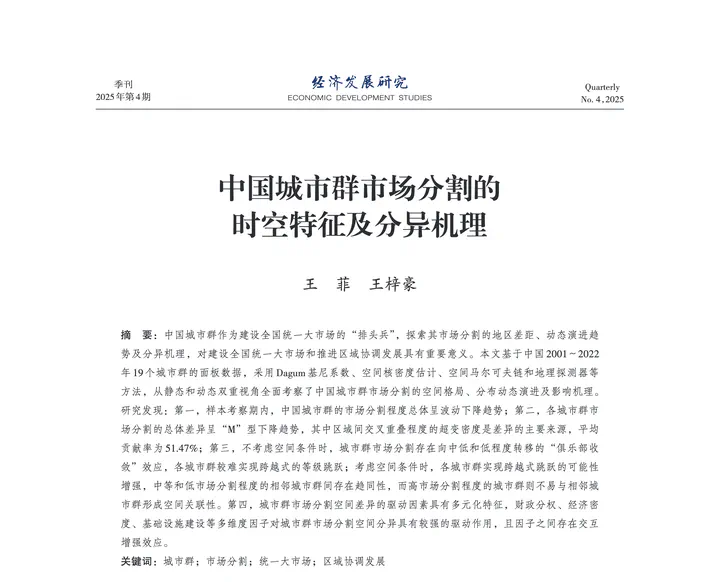 Cover page